Architect of a Butterfly Water Bottle Design
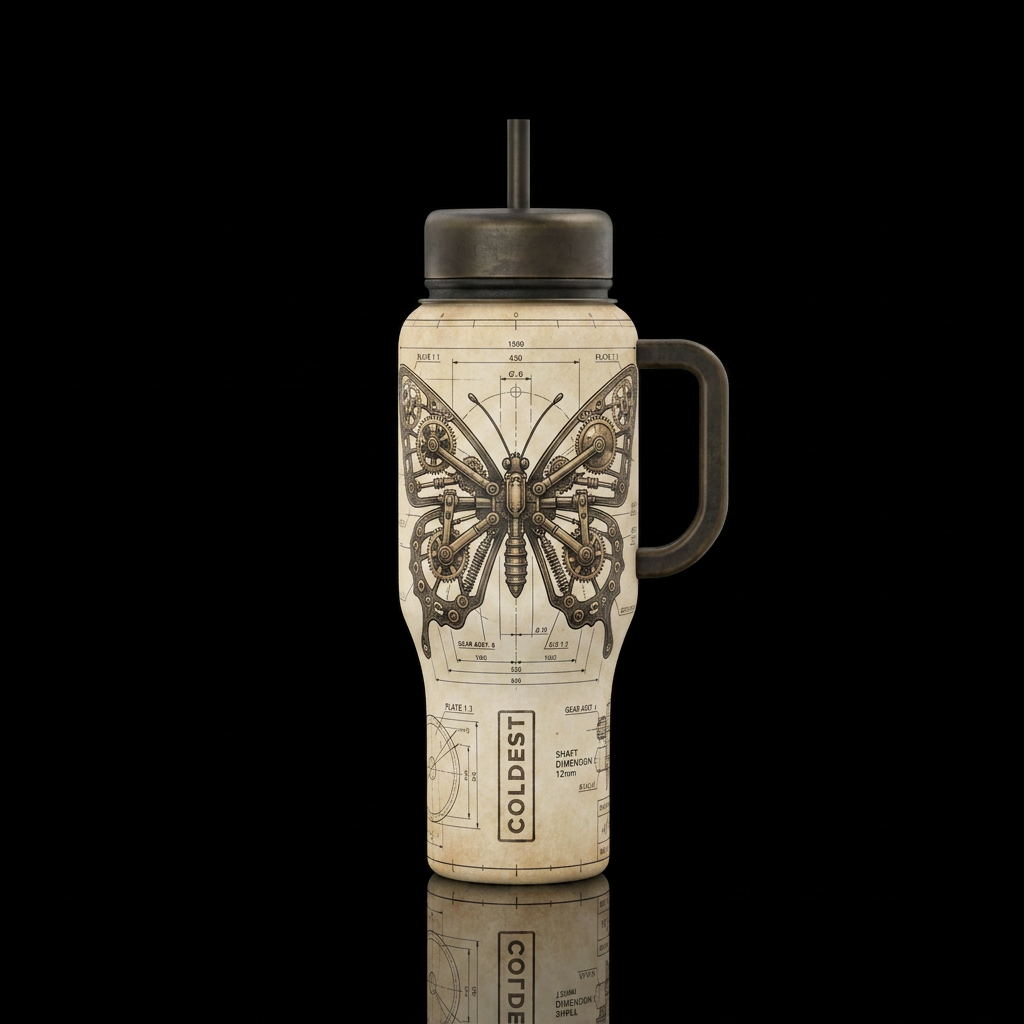
A highly detailed vintage engineering blueprint of a symmetrical steampunk mechanical butterfly, shown in precise front-facing orthographic view on aged ivory/sepia drafting paper and fitting on the bottle. The butterfly should be the dominant central object and just short of the width of the bottle. It has four smooth-edged butterfly wings with elegant, organic curves. The wings are constructed from thin metal frames and translucent ribbed panels, with realistic mechanical engineering integrated inside them. Inside each wing, arrange the mechanical components so they look genuinely functional and mechanically connected: multiple interlocking gears of different sizes, gear trains, shafts, bearings, eccentric cams, connecting rods, pivot joints, tension springs, articulated linkages, actuators, and small fasteners. Every major gear should connect logically to another gear, shaft, or linkage. Use larger drive gears near the wing roots and progressively smaller gears toward the outer wing sections. Include articulated rods following the natural structure of the wings, creating believable mechanisms for raising, lowering, and flexing the wings. The central body should resemble a compact mechanical engine or transmission housing made from layered cylindrical metal sections, riveted plates, bearings, gears, pistons, and shafts. Add two thin curved mechanical antennae and a long tail extending downward. Use a restrained antique palette: aged parchment, dark brown/black ink, bronze, brass, copper, and subtle metallic highlights. Make the mechanical butterfly highly detailed, realistic, intricate, and physically plausible rather than decorative fantasy machinery. Make the entire background an accurate engineering schematic specifically related to this butterfly. Use fine drafting grids, centerlines, construction circles, dimension lines, extension lines, arrows, section indicators, alignment marks, diameter symbols, numbered component callouts, and measurement annotations. The technical drawings should correspond to the actual geometry and mechanisms of the butterfly rather than being random background markings. Dimension lines should actually align with the butterfly's wings, body, hinges, gears, and mechanical assemblies. The layout should resemble an authentic late-19th-century / early-20th-century mechanical patent or aerospace engineering drawing rather than an artistic poster. Use only technical numbers, symbols, dimension marks, and section labels where necessary. Ultra-detailed antique technical illustration, Victorian engineering patent drawing, steampunk mechanical engineering, precise drafting, realistic brass and steel machinery, aged parchment, high detail, clean technical composition, museum-quality mechanical blueprint.
11 community votes. Designed by dads.littlefs.