Tiny World Water Bottle Design
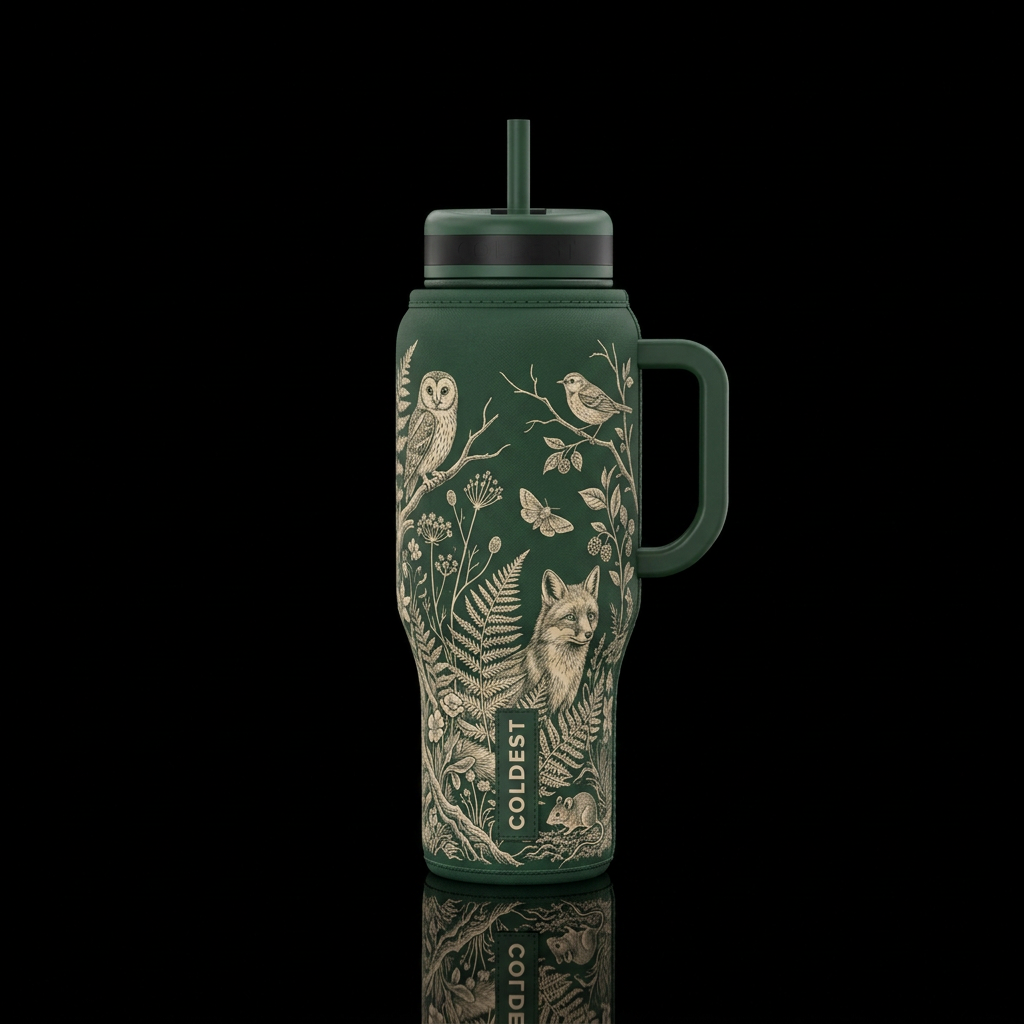
Create a premium compact personal soft-sided insulated cooler bag with a sophisticated “Tiny Worlds: Woodland” design. The product must immediately and unmistakably look like a real insulated cooler, just in a smaller personal size. It is not a miniature novelty, keychain accessory, handbag, purse, cosmetic bag, lunch tote or fashion tote. SIZE AND PROPORTIONS Design the cooler to hold approximately 4–6 beverage cans plus a small ice pack. It should feel compact and portable, but not tiny. The main cooler body should be approximately 1.4–1.5 times wider than it is tall, excluding the handles. Create a low, wide, softly structured silhouette with substantial depth. The body may taper very gently toward the bottom, but the base should remain broad and stable, almost as wide as the top. Avoid a tall vertical shape. Avoid dramatically flared tote-bag sides. Avoid a narrow bottom. The cooler should have lightly padded insulated walls, softly rounded lower corners, reinforced seams and enough structure to hold its shape while still looking tactile and soft-sided. COOLER CONSTRUCTION Use premium matte outdoor technical fabric with a subtle woven texture in a deep woodland or bottle green. Include a substantial zippered insulated lid running horizontally across the top. The top should look slightly thicker and padded so that the object clearly reads as an insulated cooler. Where appropriate, allow a very subtle glimpse of silver or light-gray thermal lining near the zipper opening to reinforce that this is a genuine cooler. The construction should look realistic and manufacturable, with clean stitching, reinforced edges and a structured flat base. HANDLES Add two short, broad, softly padded carry handles. The handles should form comfortable rounded arches but remain relatively close to the body. They should feel substantial and appropriate for outdoor equipment rather than long fashion-tote handles. Handle height should be approximately half the height of the cooler body. Keep hardware and attachments minimal and functional. No long shoulder strap, oversized buckles or unnecessary dangling accessories. The overall product silhouette should say: “beautiful little personal cooler” rather than: “handbag with a zipper.” TINY WORLDS: WOODLAND DESIGN Across the lower half of the cooler, create a continuous miniature woodland ecosystem using elegant, simplified naturalist engraving-style line art. The artwork should appear to grow naturally upward from the bottom edge rather than being placed onto the cooler as a rectangular print. Create layered woodland vegetation including: delicate fern fronds bracken fine woodland grasses tiny wildflowers and seed heads small leafy plants slender twigs and branches occasional tiny berries Keep some areas dense and other areas open so that the design has breathing room and does not become a repetitive wallpaper pattern. Hide five woodland creatures naturally inside this environment: 1. Fox Place one elegant small fox partially concealed behind ferns and woodland plants. The fox should be recognizable but should not dominate the entire design. Show a natural, alert woodland posture with realistic proportions. 2. Owl Hide a small woodland owl among branches and foliage. The owl should be significantly less obvious than the fox and become visible only when someone studies the design more closely. The owl must appear natural and anatomically believable, not cute, round, cartoonish or wide-eyed. 3. Woodland bird Place one small songbird naturally perched on a fine branch slightly higher within the vegetation. Keep the bird elegant and naturalistic. 4. Moth Include one small moth flying quietly between the plants. Keep the moth delicate and relatively subtle. 5. Field mouse Hide one tiny field mouse very close to ground level among grasses, roots or fern stems. The mouse should be one of the hardest elements to notice. COMPOSITION This is extremely important: The viewer should first perceive a beautiful woodland landscape. Only afterward should the viewer begin discovering: “There’s a fox.” “Wait, there’s an owl in the branches.” “And there’s a tiny mouse down there.” The animals must therefore not look like five separate illustrations arranged across the bag. Integrate every creature organically into the same continuous habitat. The vegetation remains the dominant visual element. The fox can be the easiest animal to discover. The bird and moth are secondary discoveries. The owl and mouse should be deliberately hidden. ART STYLE AND MANUFACTURABILITY Use sophisticated vintage natural-history engraving and botanical field-guide illustration as inspiration, interpreted with modern restraint. Use only one warm antique-ivory, parchment or very muted champagne tone for the woodland illustration against the deep green fabric. Keep linework crisp and intentionally simplified enough to be realistically reproduced on fabric. The artwork must look intentionally drawn for real commercial production, not like a highly detailed digital painting. No photographic wildlife. No gradients. No watercolor. No glowing effects. No complex shadows within the printed artwork. No hyper-detailed fur. No fake 3D animals. No random ornamental flourishes. Do not make the animals symmetrical or evenly spaced. Avoid obvious AI-art characteristics such as malformed foliage, duplicated plants, merged animal anatomy, impossible branches or excessive meaningless detail. BRANDING Allow a small, restrained rectangular area near the upper center of the front panel for discreet brand placement. Keep branding secondary to the overall product design. Do not place large text across the woodland illustration. OVERALL AESTHETIC Sophisticated, quietly luxurious, outdoorsy, naturalist, collectible and slightly mysterious. Designed for an adult who genuinely loves forests, birds and wildlife rather than someone looking for a cute animal accessory. The cooler should look beautiful from several feet away because of its shape, deep green fabric and subtle botanical pattern. From close range, the hidden animals reveal themselves and create the Tiny Worlds experience. The design should feel timeless rather than trendy. Absolutely avoid: childish or kawaii styling, cartoon animals, smiling animals, exaggerated eyes, oversized animal heads, plush-toy styling, fantasy creatures, obvious AI aesthetics, multicolored wildlife graphics, floral handbag styling, long fashion handles, narrow tote proportions, lunch-bag styling, excessive hardware, large slogans and overly busy decoration. PRODUCT VISUALIZATION Show the finished cooler as a highly realistic commercial product prototype on a simple dark or neutral studio background. Use a three-quarter front view so the width, depth, padded cooler construction, zipper, base and both handles are clearly visible. The entire product must be visible in frame. Prioritize accurate product proportions and manufacturable construction over artistic presentation.
1 community votes. Designed by magdalenawilcox1.